
August 26, 2026
By Tracie Troha
A new paper co-authored by Aaron Young, professor and James R. and Sarah R. Borders Faculty Fellow in the George W. Woodruff School of Mechanical Engineering, was recently published in Nature Machine Intelligence.
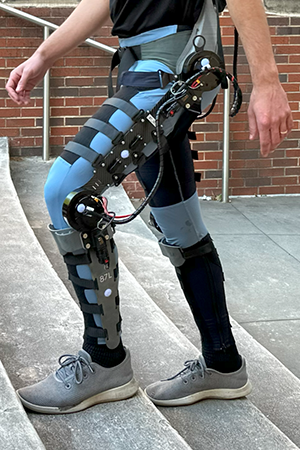
The paper, “A roadmap for end-to-end task-agnostic exoskeleton control,” examines how artificial intelligence could enable lower-limb exoskeletons to provide assistance across a wide range of human movements and activities.
Young, who leads the Exoskeleton and Prosthetic Intelligent Controls Lab, and his collaborators highlight the potential of using real-time estimates of a person’s movements to create more flexible and robust exoskeleton control systems. These systems could benefit people with mobility impairments, older adults, and workers in physically demanding environments. The paper also identifies key challenges that must be addressed before these systems can be widely adopted, including safety, optimization, sensing, and training data requirements.
In addition to Young, the paper’s co-authors include Woodruff School Ph.D. student Ethan Schonhaut; Woodruff School alumnus Keaton Scherpereel, M.S. ME 2022, Ph.D. ME 2024, and engineer at Skip Innovations; and Max Shepherd and Fatima Mumtaza Tourk of Northeastern University.
In addition to being published in Nature Machine Intelligence, the research was featured in a news article in Nature.