
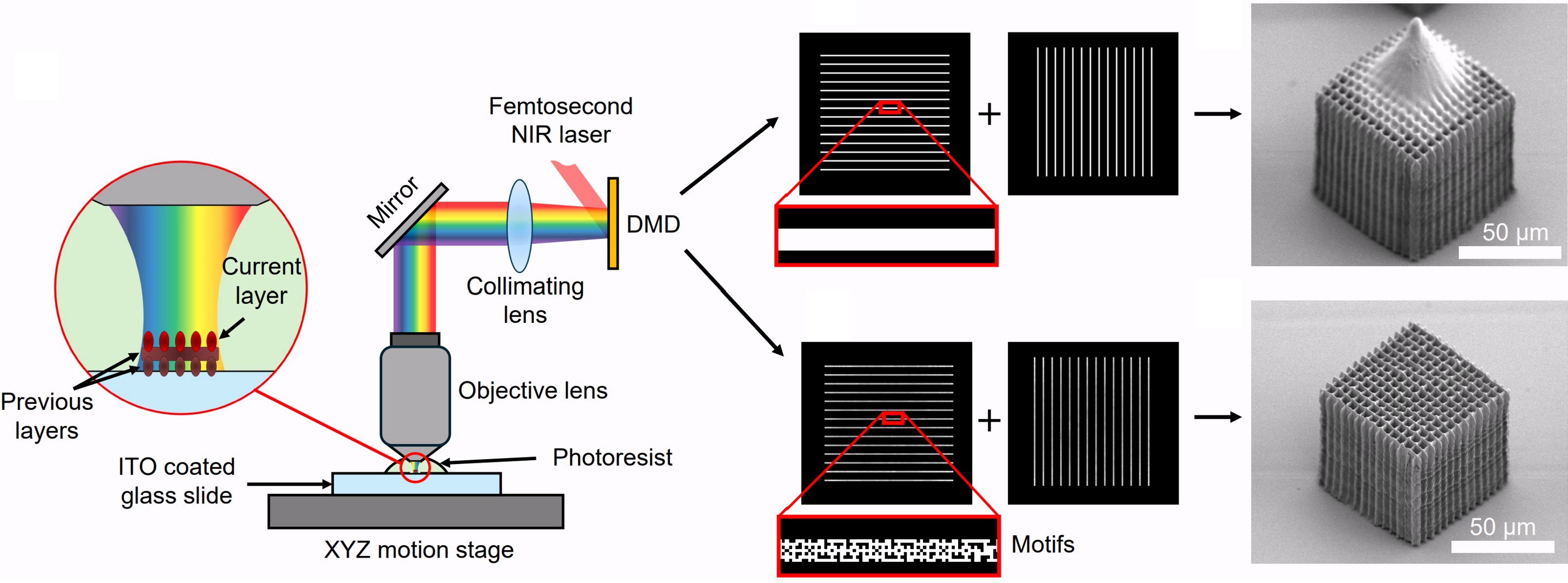
Fig. 1: Grayscale projection two-photon lithography using sub-diffraction motifs.
Researchers Advance Nanoscale 3D Printing With Faster, Higher Fidelity Method
July 24, 2026
By Tracie Troha
Researchers at the George W. Woodruff School of Mechanical Engineering have developed a new approach to nanoscale 3D printing that improves both speed and fidelity, overcoming a challenge that has limited the technology's broader use in manufacturing.
Their work, led by Sourabh Saha, associate professor and Woodruff Faculty Fellow, and Harnjoo Kim, who conducted the research during his doctoral studies and later as a postdoctoral fellow in Saha's lab, was recently published in the journal Nature Communications.
Nanoscale 3D printing allows researchers to create structures thousands of times smaller than the width of a human hair. These structures have potential applications in fields ranging from advanced computing and optics to biomedical devices and clean energy technologies. However, increasing printing speed often comes at the expense of quality.
"Many nanoscale 3D printing methods can produce very precise structures, but they are too slow for practical production," Kim said. "On the other hand, high-speed approaches often lose accuracy because it becomes difficult to control the printing process."
Several years ago, Saha's research group demonstrated a way to dramatically increase printing speed by processing entire planes of material at once rather than printing one point at a time. While that approach accelerated manufacturing, maintaining precise control over the amount of light delivered to different areas of a structure remained a challenge.
“When you process one point at a time, it is easy to control the light dosage,” Saha said. “However, when multiple points in a plane are processed at once, it becomes challenging. As light dosage must be controlled to produce accurate prints, we had no good way to independently control dosage at various spots within the plane.”
To solve that challenge, Saha and Kim developed a motif-based approach. Rather than controlling an entire light pattern at once, they build it from many small, carefully designed elements, similar to how an artist creates a painting with deliberate brushstrokes.
“Our approach keeps things simple by assembling the final pattern from many small, predictable pieces that are more like deliberate brushstrokes than a single wild splash,” Saha said.
The technique uses a device that can only turn pixels on and off. Conventional thinking suggests that such a system can create only two levels of light intensity. The team found a way to produce many intensity levels by arranging on-and-off pixels into precise patterns.
The breakthrough relies on diffraction, a fundamental property of light that typically limits how tightly light can be focused. Rather than treating diffraction as an obstacle, the researchers turned it into an advantage.
"Often, the diffraction limit is considered a nuisance," Saha said. "For us, it became an enabler."
By carefully designing patterns smaller than the diffraction limit, the team was able to precisely control how much light reached different parts of the printing area while maintaining a consistent spot size. The result was more accurate printing without sacrificing speed.
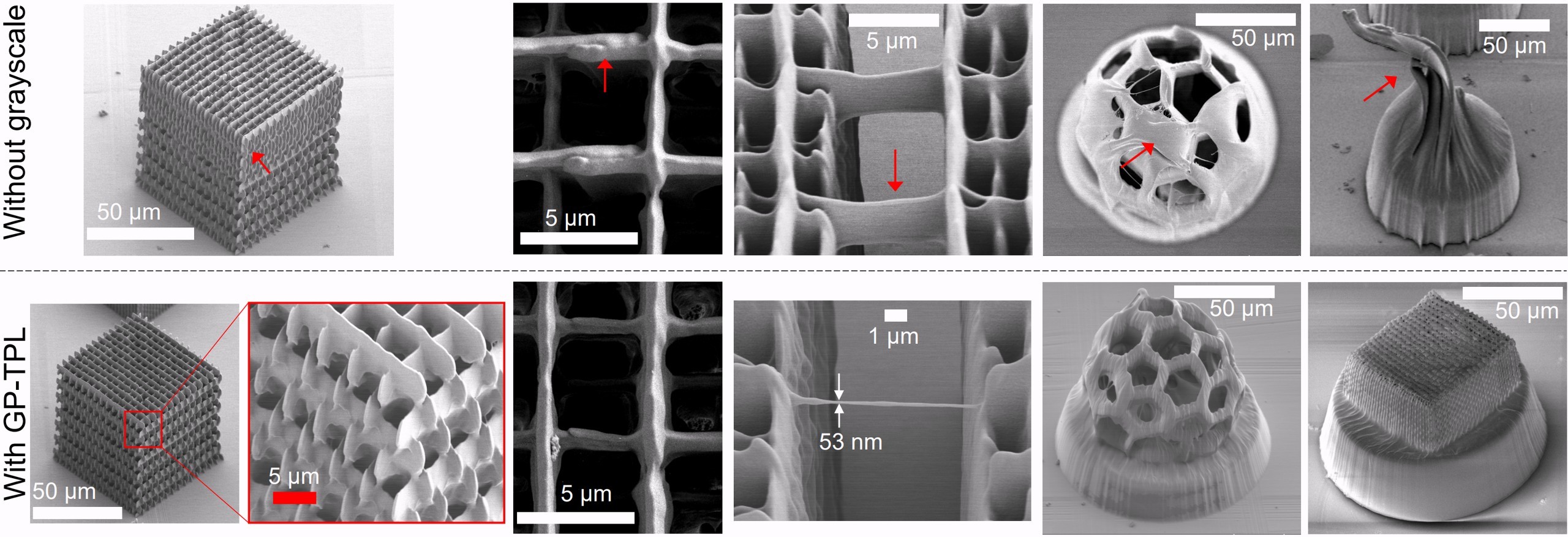
Fig. 5: Ultrafast and precise nanoscale 3D printing enabled by grayscale projection two-photon lithography (GP-TPL).
The researchers' original goal was to improve printing fidelity while maintaining high throughput. Instead, the new method improved both. Compared with the group's previous work, the technique increased printing speed by roughly 100 times while also enabling finer control of printed features.
One of the most rewarding moments of the project, Kim said, was seeing the concept work in practice.
“Seeing those simulations translate into real experiments and producing more accurate printed structures was extremely exciting,” he said. “It felt immensely rewarding to discover a new way to overcome a long-standing limitation in projection-based nanoscale 3D printing.”
The research could benefit a wide range of future technologies, including micro-optical components used in imaging and communications systems, next-generation sensors, biomedical devices, microelectromechanical systems and mechanical metamaterials.
The research was also motivated by a long-term goal in Saha's lab to produce fuel capsules for inertial fusion energy. These tiny fuel capsules have strict geometry requirements and cost tens of thousands of dollars to make. For fusion energy to become commercially viable, Saha said, that cost must be below $1.
"Real-world applications require one to meet stringent geometric constraints," Saha said. “For example, the lid of a can must be a certain size to have a leak-free closure. Similar constraints exist for nanoscale functional structures. Additionally, printing speed directly impacts whether we can produce the parts in a reasonable time and how expensive each part is. Thus, achieving both high accuracy and high speed is extremely important.”
The technology has already begun to move beyond the laboratory. Kim recently completed his postdoctoral fellowship and co-founded Stellar Scale Nano Foundation with Saha and Harry Watkins, a Georgia Tech undergraduate studying computer engineering, to commercialize the printing technology. Incubated at Georgia Tech, the startup has secured $2 million in pre-seed funding.
By overcoming a longstanding tradeoff between precision and speed, the team’s approach brings nanoscale additive manufacturing one step closer to real-world industrial applications. Through the startup, they are now working to translate the technology from the laboratory into scalable manufacturing solutions for applications ranging from advanced optics and computing to fusion energy.