
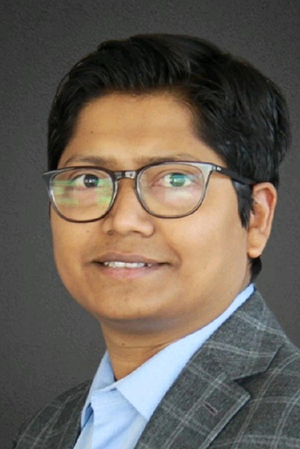
Get to know one of the Woodruff School's newest faculty members.
January 12, 2026
By Mikey Fuller
Ferdous Alam recently joined the George W. Woodruff School of Mechanical Engineering as an assistant professor, bringing a research focus at the intersection of artificial intelligence, robotics, and manufacturing. His work centers on developing AI-driven methods for computational design and “embodied intelligence,” enabling robotic systems to reason about 3D shapes, simulation, and real-world engineering tasks.
In this Q&A, Alam shares what drew him to Georgia Tech, the mentors who influenced his path, and his excitement about teaching foundational computing skills while building a research lab focused on next-generation engineering intelligence.
Welcome to the Woodruff School! How did you make the decision to come to Georgia Tech?
Georgia Tech offers tremendous resources and collaboration opportunities that align perfectly with my research vision. Additionally, Tech is home to one of the top engineering student bodies in the country. This combination is particularly important to me as I work in a rapidly emerging area of mechanical engineering focused on creating novel AI methods for computational design and robotic manufacturing. Given Tech’s world-leading expertise in robotics, AI, and manufacturing, I felt right at home.
What courses will you be teaching?
I will be teaching ME 2016 Computing Techniques. This is a fundamental undergraduate course, and I am very excited to teach these fundamentals with a modern computational stack so students are prepared for any demanding computational task.
What is the focus of your research?
Inspired by the emergence of recent general intelligence models like vision-language foundation models, my work focuses on bringing similar capabilities to the physical engineering world. I am creating novel representation methods and AI foundational models to understand 3D shapes and unify design-simulation reasoning. Finally, I also work on integrating these AI methods directly with robotic systems, enabling "embodied intelligence" for precision engineering tasks. The ultimate goal is to build versatile tools for design, simulation, and manufacturing that can handle unstructured real-world problems.
What breakthroughs would you like to see in your field of research over the next decade?
I would like to see the emergence of artificial general engineering intelligence where a new generation of AI can think and reason like us and work as true intelligent co-pilot for engineers. The impact would be transformative as we would iterate faster, design faster, build faster, and support unprecedented innovation to uplift the quality of human life.
Who are some of your career influences?
My earliest influence was my sister, a chemist, who sparked my passion for science and engineering at a young age. Later in my career, I was deeply shaped by my Ph.D. advisor, David Hoelzle, and my postdoc advisor, Faez Ahmed. They taught me that rigorous intellectual curiosity goes hand-in-hand with kindness and empathy. I am dedicated to passing those values on to the next generation of engineers.
What achievements are you most proud of in your career?
More than any research paper, I am proudest of the students I’ve mentored. Seeing them evolve as researchers and achieve their own milestones is incredibly fulfilling. I view mentorship as a core responsibility and am deeply committed to seeing my students succeed at the highest levels.
What do you enjoy about working in academia?
I am passionate about breaking down complex engineering concepts so students can learn from first principles and solve real-world problems. Seeing that "click" happen is incredibly rewarding. Beyond the classroom, I value the academic freedom to pursue impactful research work that has the potential to improve quality of life and address long-standing societal challenges.
What is the biggest challenge of being a new professor on campus?
I am still learning to navigate the campus and trying to learn the shortcuts to different buildings and classrooms.
What are you most excited about as you begin your work at Georgia Tech?
I am most looking forward to working with the passionate student body that Tech is known for. On the research side, I am excited to build a lab that can be one of the leading research labs in my field.
What do you enjoy doing for fun?
Music is a huge part of my life, and I love unwinding with my guitar whenever I have the time. I also like playing soccer and badminton. Another thing that I really enjoy is experimenting with new recipes for cakes and pastries.