
Explain It! – The Engineering Vertical Video Competition
The 2026 undergraduate communication challenge asks engineering students to make complex technical ideas accessible and engaging for non-engineers.
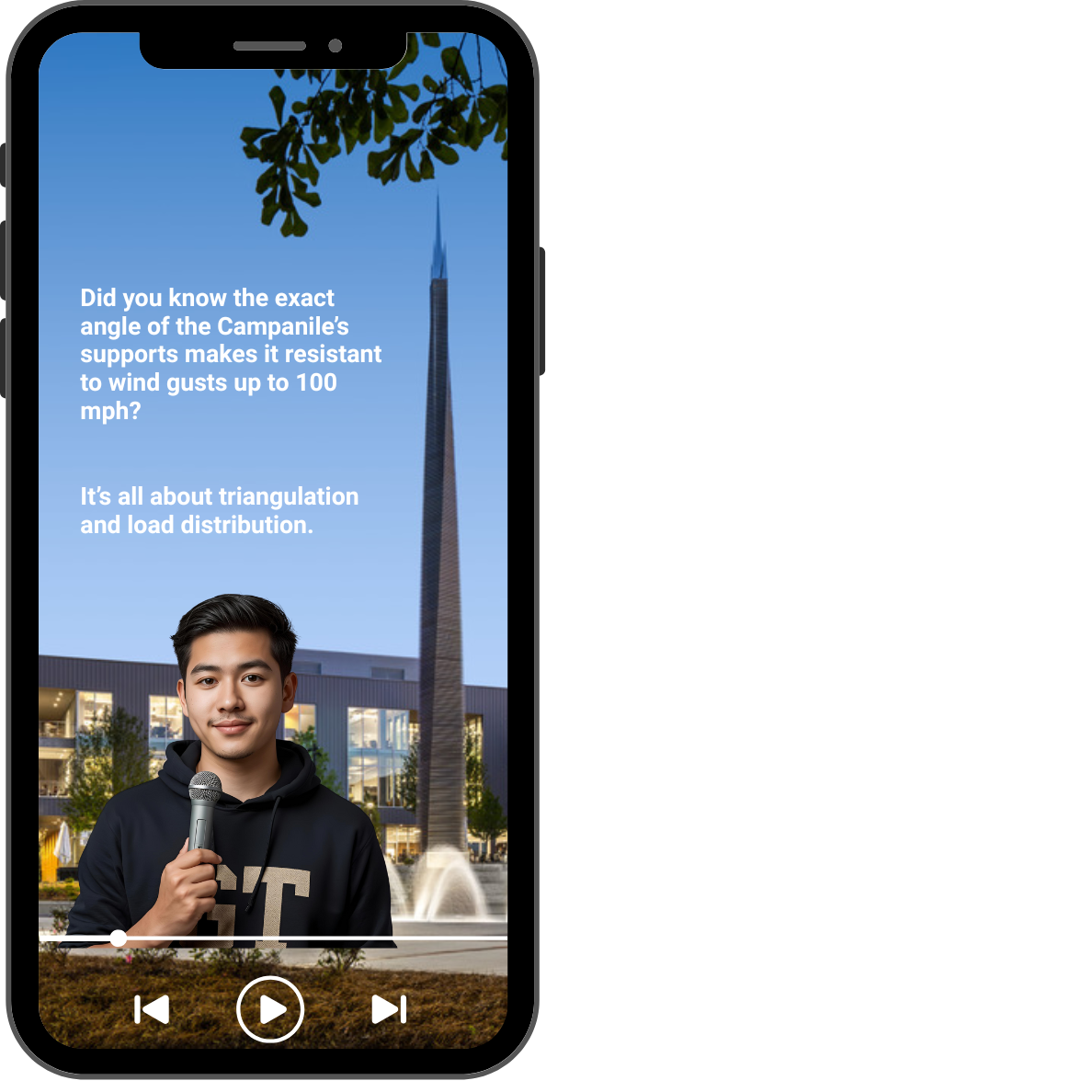
Students will create a vertical short-form video that explains an engineering concept clearly, accurately, and memorably for a general audience.
Submission Guidelines
- Format: Vertical video (9:16 aspect ratio)
- Length: Maximum 60 seconds
- Eligibility: Open to all Woodruff undergraduates. Must be present at the Competitions Reception on March th.
- Topic: Any engineering concept, principle, or device that can be explained in clear, accessible language.
- Tone: Conversational, confident, and audience-focused—aimed at viewers with no formal technical training. Think MrBeast meets Hank Green: energetic, engaging, and crystal-clear.
- Visuals: Students are encouraged to use props, demonstrations, animation, or creative visuals that enhance understanding.
- Appearance: The presenter must appear on camera for at least part of the video to establish connection and credibility.
Prizes
1st Place: $2500
2nd Place: $2000
3rd Place: $1500
4th Place: $1000
5th Place: $500
Submissions Due 3/2
Evaluation and Awards
Finalists will be invited to showcase their videos during the 2026 Webb-Donnell Communication Competitions, where winners will be recognized for outstanding communication skill and creativity. Selected videos may also be featured on the Woodruff School’s website and social media channels to highlight the role of engineers as public communicators.
Use of AI and Presentation Modes
To recognize the diverse communication strengths of engineering students, the Explain It! competition allows flexibility in how competitors design and deliver their videos. Students may choose the presentation mode that best supports their message and comfort level while maintaining authenticity and ethical standards.
Competitors may select one of the following modes:
- Presenter Mode
- The competitor appears on camera as the explainer. Visual aids, props, sketches, or on-screen graphics may be used to clarify or emphasize key ideas.
- The speaker’s face and voice must appear in the final video.
- All narration and editing must be original to the student.
- The competitor appears on camera as the explainer. Visual aids, props, sketches, or on-screen graphics may be used to clarify or emphasize key ideas.
- Designer Mode
- The competitor may use generative AI tools—such as Sora, Runway, Pika, D-ID, or similar platforms—to create animations or scenes that visualize their explanation.
- The narration, concept selection, and script must be entirely student-created.
- The student’s own likeness and voice must be used. Videos that depict or clone another person’s appearance, identity, or voice are not permitted.
- The competitor may use generative AI tools—such as Sora, Runway, Pika, D-ID, or similar platforms—to create animations or scenes that visualize their explanation.
All entries that incorporate AI tools must include a brief disclosure statement in their submission form. Example:
“I used Sora to generate the animation of fluid flow. The narration, likeness, and voice are my own.”
Support Resources
(text and background only visible when logged in)